Why is durability the first criterion for all-terrain football procurement?
When purchasing footballs, most people first look at feel, bounce, and brand, but what truly determines whether you need to buy another one a year later is durability. Especially when the usage scenario involves concrete, dirt fields, or hard street surfaces, durability is not a 'bonus point' but a 'lifeline'.
Concrete and dirt fields: Why do ordinary footballs wear out quickly?
The leather and craftsmanship of ordinary footballs are typically designed for grass or artificial turf, with relatively smooth surfaces and low friction. Once placed on concrete or dirt fields, the situation is completely different:
- Concrete:The surface is rough and hard, and every touch, roll, and tackle is like 'sandpaper polishing'.The PU surface of a regular soccer ball shows obvious wear after dozens of intense uses, starting with surface fuzzing, followed by peeling of the surface layer, and finally exposing the bladder and deforming the ball.
- Sandy or gravel fields: Sand and gravel particles act as abrasives when the ball contacts the ground, accelerating surface wear.At the same time, sand entering the seams can affect air tightness and the roundness of the ball.
The core difference of all-terrain soccer balls lies in the thickness of the material and the design of the wear-resistant layer. Taking Winsunsport's all-terrain universal soccer ball as an example, its material thickness supports customization, meaning you can choose a thicker wear-resistant material based on actual field conditions, rather than passively accepting a standard configuration. The material thickness of a regular soccer ball is usually around 1.0mm, while all-terrain soccer balls can be made thicker, directly extending the service life.
The relationship between wear resistance and long-term procurement costs
Here is a simple calculation:
Assuming a regular football costs 80 yuan per unit and is used intensively on concrete ground, it needs to be replaced about every 2 months, requiring 6 replacements a year, with an annual cost of 480 yuan. An all-terrain football may cost 200 yuan per unit, but its service life can reach 8-12 months, requiring 1-1.5 replacements a year, with an annual cost of 200-300 yuan.
Key Decision Points:
| Usage Scenario | Annual Cost of Regular Football (Estimated) | Annual Cost of All-Terrain Football (Estimated) | Conclusion |
| Used on concrete 2-3 times per week | 240-360 yuan | 200-300 yuan | The difference is small, but all-terrain is more worry-free |
| High-intensity daily training on concrete | 480-720 yuan | 200-400 yuan | All-terrain is clearly more cost-effective |
| Occasional grass + occasional hard ground | 160-240 yuan | 200-300 yuan | Regular footballs are sufficient; all-terrain ones are overpriced |
Who should directly choose an all-terrain football: On school concrete playgrounds, street courts, and multi-surface youth training—these scenarios have uncontrollable field conditions, and wear resistance directly determines the ball's lifespan.
Who can hold off for now: If you only use it on standard grass or artificial turf, and the frequency of use is very low (a few times a month), the wear rate of a regular football is perfectly acceptable, and there's no need to pay extra for wear resistance you won't use.
Next step: confirm the action: Confirm with the Winsunsport team the specific conditions of your venue (roughness of the concrete floor, sand-to-soil ratio, frequency of use), as well as the customization plan for the corresponding leather thickness and expected lifespan. They can recommend the appropriate leather thickness based on your actual usage intensity, rather than letting you blindly choose the thickest configuration.
Three self-executable abrasion resistance test methods
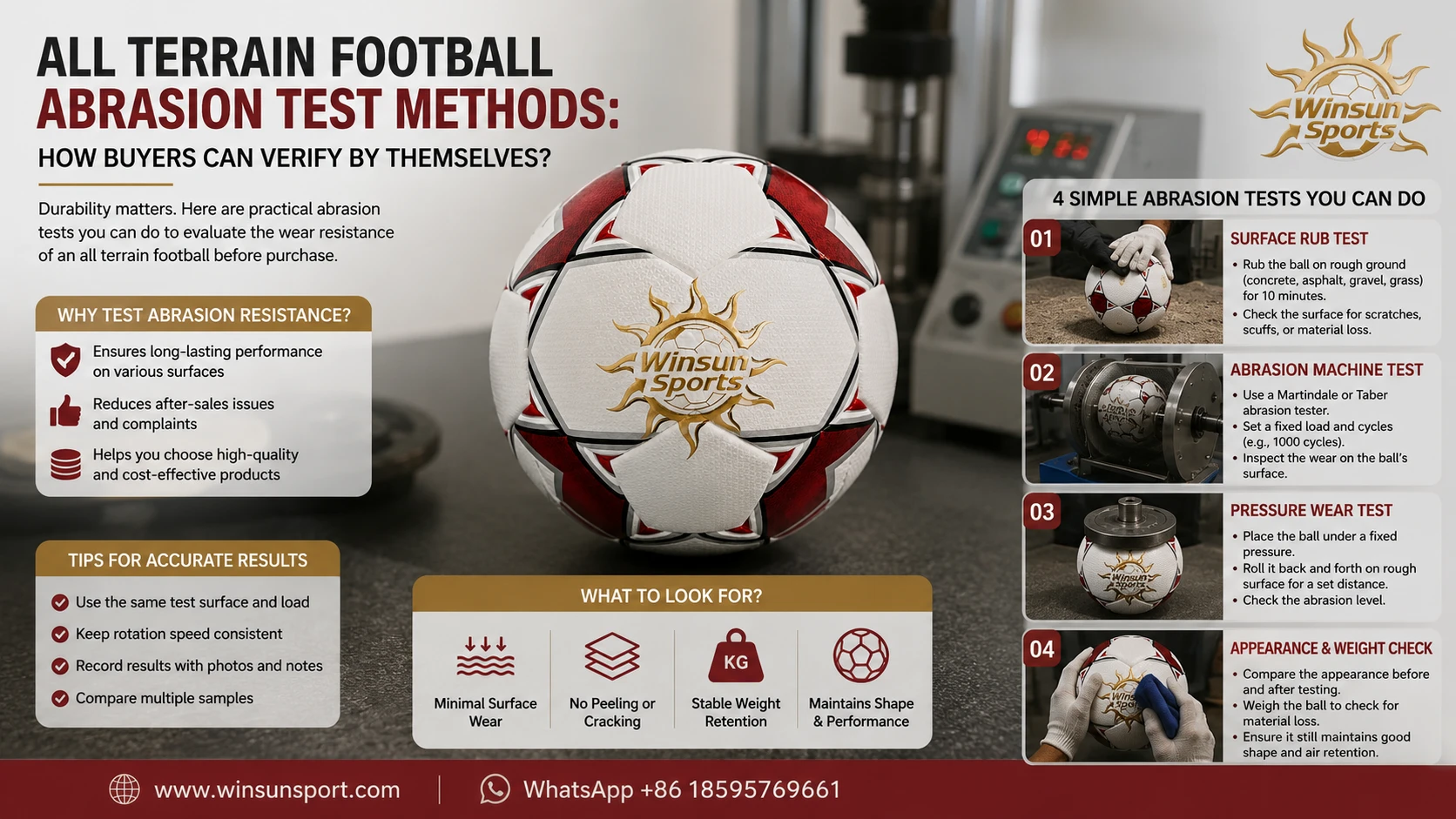
When purchasing footballs, abrasion resistance is one of the most difficult indicators to judge from appearance. Instead of trusting marketing slogans, spend 15 minutes doing three simple tests before paying. The following methods do not require professional equipment and can be completed in an office or warehouse.
Simulated friction test: Use simple tools to compare wear rates
This test directly answers the question of 'how long it can last on concrete or sandy fields.'
Operation steps:
- Prepare a rough surface - cement brick, coarse sandpaper (40-60 grit), or a wooden board covered with a thin layer of sand.
- Secure the football (you can hold it between your legs or place it on a sandbag) to ensure it doesn't roll during the test.
- Using the same rough material, rub the same area of the ball back and forth 30 times with the same force and speed.
- Observe the changes on the ball's surface: whether there is obvious pilling, color fading, peeling of the surface layer, or exposure of the inner fabric.
Judgment criteria:
- Excellent: The surface has only slight abrasions, no color fading or pilling, and no obvious roughness when touched by hand.
- Pass: Visible wear marks on the surface, but without damage to the internal structure, with slight color fading.
- Fail: Severe pilling on the surface, obvious color fading, or exposure of the underlying material.
Key Reminder: Testing only one ball is meaningless; you must conduct comparative tests with two candidate brands using the same number of repetitions and the same force. If conditions permit, use an electronic scale to weigh the ball before and after friction—the weight difference of worn-off material is more objective than visual observation.
Actual Court Testing: Verify in Real-World Conditions
Simulated friction can only test the surface; wear in actual use also includes impacts from kicking, stepping on, and repeated bouncing against the ground. If the purchase volume is large, it is worth conducting a real field test.
Operation steps:
- Choose a surface closest to the actual usage scenario—cement playground, plastic track, or dirt field.
- Kick the ball toward the ground 20 times with normal kicking force, allowing the ball to bounce naturally several times each time.
- Then have 2-3 people dribble and pass the ball normally for 10 minutes to simulate the frequency of touches in a real game.
- Immediately after, check: whether there are cracks on the ball surface, whether the seams are splitting, and whether the area around the valve is loose.
Judgment criteria:
- Check the seams—this is the weakest point.If cracks or loose threads appear at the seams, it indicates that after long-term use, the ball will likely start to break down from there.
- Check the valve — apply soapy water around the valve and see if bubbles appear, to rule out air leakage.
- Weigh and compare — if the weight difference before and after the test exceeds 5 grams, it indicates noticeable water absorption or wear. Such balls will get heavier and heavier when used on rainy days or on damp fields.
Applicable scenarios: If the purchase quantity is more than 20 balls, or if these balls will be used in high-wear environments such as concrete playgrounds or street courts, the actual field test is well worth doing. If you are just buying 1-2 balls for personal use, the simulated friction test is sufficient.
Quick judgment method: three checks you can do without opening the packaging
When you don't have the conditions to conduct a full test, use these three checks to quickly filter out products that are obviously not durable:
- Press the outer surface: Press the spherical surface firmly with your thumb, then release and observe the rebound speed.If the rebound is slow or leaves a dent, the leather is relatively soft and wear resistance is usually poor.
- Observe the texture: A ball with a surface texture that is too fine and smooth often has poorer wear resistance on rough ground than a ball with obvious granular texture.The texture itself acts as a 'sacrificial layer'.
- Check air tightness: After fully inflating, leave it for 24 hours, then press with your hand to feel the change in air pressure.A ball with poor air tightness requires frequent reinflation, and frequent reinflation accelerates the fatigue of the leather around the valve.
Conclusion and Next Steps
Among these three methods,simulated friction testingoffers the best cost-effectiveness, yielding valid comparative data in just 10 minutes;actual field testingis the most reliable, suitable for final confirmation before bulk procurement;quick inspectionis suitable for the initial screening stage.
It should be noted that these methods can only verify "relative abrasion resistance" and cannot provide a more reliable figure for "how many months it can be kicked"—that depends on the roughness of the playing surface, frequency of use, and kicking force. If you have already determined the playing surface and approximate frequency of use, you can directly explain these conditions to the Winsunsport team. They will confirm whether the leather thickness and workmanship of this all-terrain universal football can meet your expectations based on your actual scenario.
Judging the upper limit of abrasion resistance from leather thickness and workmanship
Many buyers, upon receiving samples, first thing they do is check the leather thickness. This action is not wrong, but checking only thickness is far from enough. To judge the upper limit of abrasion resistance of an all-terrain football, you need to look at the leather thickness, bladder structure, and stitching process simultaneously. These three factors together determine how long the ball can last on concrete or sandy fields.
Leather thickness: How customization affects abrasion resistance
The leather thickness of this All Terrain Universal Football is a "custom" option, not a fixed value. This means that buyers need to clarify the usage scenario before placing an order: if it is mainly used on school cement playgrounds or street hard surfaces, thicker leather should be chosen;If the main use is grass training, standard thickness is sufficient, and too thick may affect the touch.
When checking leather thickness, do not only look at the product page labels; it is recommended to ask the team for actual samples or cross-section data. Press the ball surface with your hand; thick leather usually rebounds slower and has greater pressing resistance;Thin leather is softer and fits the hand better. But note that leather thickness only determines the 'starting point' of outer wear resistance; what truly determines the upper limit of wear resistance is the inner bladder and craftsmanship.
Workmanship details: stitching, bonding, and edge treatment
No matter how thick the leather is, if the stitching breaks first or the edges peel first, wear resistance is meaningless. When inspecting the workmanship, focus on three key areas:
- Stitching: Check whether the stitches are even and whether the thread is exposed.Exposed thread ends will be the first to wear through when rubbed against rough ground, causing the ball to split open.
- Edge bonding: Check whether there is excess glue or lifted edges at the seams between panels.Lifted edges mean they will be 'peeled up' first on hard ground, accelerating damage.
- Bladder structure: This product offers three choices of bladder: thread-wound bladder, rubber thread-wound bladder, and PVC bladder.The thread-wound bladder has a tighter structure and stronger resistance to deformation;The PVC bladder is low-cost but has weaker long-term abrasion resistance than the rubber thread-wound bladder.If you use it frequently or on rough surfaces, it is recommended to choose the rubber thread-wound bladder.
The misconception that "the thicker the leather, the better"lies in ignoring the synergistic effect of the inner bladder and the craftsmanship. A ball with thick leather and an ordinary PVC bladder, after being kicked on hard ground for a few months, may have an intact surface, but the deformation of the inner bladder causes the ball to lose its roundness and bounce erratically, so it still needs to be replaced. Conversely, a ball with medium-thickness leather and a rubber thread-wound bladder can maintain more reliable abrasion resistance while sustaining stable performance for a longer period.
Next step: confirm the action: Clearly communicate your primary field type and weekly usage hours to the team, and ask them to provide corresponding leather thickness recommendations and bladder pairing solutions. If the budget allows, you can request samples, focusing on pressing the ball surface to feel the thickness, observing whether the stitching is recessed, and pulling at the seams with your hands to see if they are loose. After completing these three checks, you will have a good idea of the wear resistance limit.
Make the final purchasing decision based on the bladder and usage scenarios
Impact of bladder type on durability
The bladder is the core component that determines the upper limit of a football's durability and must be evaluated in conjunction with the leather's wear resistance. The differences among the three bladder types are as follows:
| Bladder type | Durability Features | Suitable Scenarios |
| Thread Core | Multi-layer yarn winding, uniform rebound, resistant to deformation over long-term use | Grass fields, plastic courts, high-frequency training and matches |
| Rubber Core | Balances elasticity and puncture resistance, more stable performance on rough surfaces | Cement playgrounds, street dirt courts, and other high-wear surfaces |
| PVC bladder | Lower cost, acceptable air tightness, but elasticity decays faster after high-intensity use. | Low-frequency recreational use, procurement with limited budget. |
Selection advice: For high-frequency use on rough surfaces, prioritize rubber thread-wound bladders;For those mainly training on grass and seeking stable touch, thread-wound bladders are more suitable;PVC bladders are only suitable for low-frequency leisure scenarios, and long-term costs may not be lower.
Match wear resistance requirements according to usage scenarios
Different surfaces have significantly different wear resistance requirements; refer to the following matching logic:
- Cement playground: The ground is rough and hard, causing significant wear on the leather and bladder. It is recommended to choose a rubber-wound bladder and confirm the leather thickness option.
- Multi-field training for youth development: Frequent field rotation requires a balance of wear resistance and elastic stability. Both wound and rubber-wound bladders are acceptable; the key is to confirm that the specifications match the age group.
- Grass football field: Wear is relatively low, and the advantage of uniform rebound from a wound bladder is more prominent, providing a more stable feel.
- Street or sandy soil venues: Sand and gravel can easily scratch the ball surface, making the puncture resistance of a rubber-wound bladder more practical.
- Indoor hard court: Also a rough surface with high abrasion resistance requirements, but attention must be paid to whether the bounce tuning suits indoor spaces, to avoid excessive rebound that is hard to control.
Final judgment:
- Situations suitable for choosing the All Terrain Universal Football: Training or match venues are not fixed, and a single ball is needed to handle various surfaces such as concrete, grass, and sandy soil;High usage frequency, with the desire to reduce replacement frequency and long-term costs;Youth training teams or school procurement, requiring multiple specifications matched by age group.
- Situations requiring further confirmation of needs: If the primary playing surface is single and fixed (e.g., only high-quality natural grass), a professional match ball may offer a more refined touch on that specific surface; it is recommended to compare and test-kick first;If the budget is extremely limited and the frequency of use is very low, a regular football can also meet basic needs, and the all-terrain feature may not be worth the extra investment.In addition, if it involves wet and slippery surfaces on rainy days or special requirements for elasticity, it is recommended to confirm the applicable boundaries of the specific model with the Winsunsport team.
Frequently Asked Questions
Q: Is an all-terrain football really more durable than a regular football on concrete? This is mainly due to the combined design of wear-resistant leather and the inner bladder structure. Regular footballs are mostly optimized for grass and wear out faster on concrete;All-terrain footballs have anti-wear treatment on the leather thickness and bladder structure, but the actual durability is related to the frequency of use and kicking style. Before purchasing, you can confirm the leather thickness options with the supplier.
Q: Can players of different age groups in the youth training team use the same ball? Not recommended. Different age groups have different requirements for ball weight and size; using the wrong specification can affect the development of technical skills.
This ball is available in multiple specifications, so it is more reasonable to purchase separately according to age group.
Q: Is the all-terrain football suitable for indoor hard courts? Yes. Indoor hard courts are considered rough surfaces, and the all-terrain football's wear-resistant properties are advantageous.
However, indoor spaces are smaller, and if the bounce is too strong, it may be difficult to control. It is recommended to confirm whether the bounce adjustment meets indoor usage requirements.
Q: How to choose between a thread-wound bladder and a rubber bladder? It mainly depends on the playing environment: if you mainly play on grass or synthetic turf, the thread-wound bladder provides more uniform rebound and better feel;if you often play on concrete or sandy fields, the puncture resistance of the rubber bladder is more practical. Both are durable, the difference lies in their adaptability to rough surfaces.
Q: What should be confirmed with Winsunsport before purchasing? It is recommended to confirm three things: first, the applicable specifications and corresponding age group;second, the leather thickness options and abrasion resistance level;third, whether the rebound tuning is suitable for the most frequently used field type. Once confirmed, you can basically determine whether this ball matches your procurement needs.
Learn More
If you are selecting footballs for schools, youth training teams, or multi-field usage scenarios, you are welcome to submit your field conditions and usage frequency to the Winsunsport team. We will recommend suitable leather thickness and bladder combinations based on actual needs.
Related Products:All Terrain Universal Football