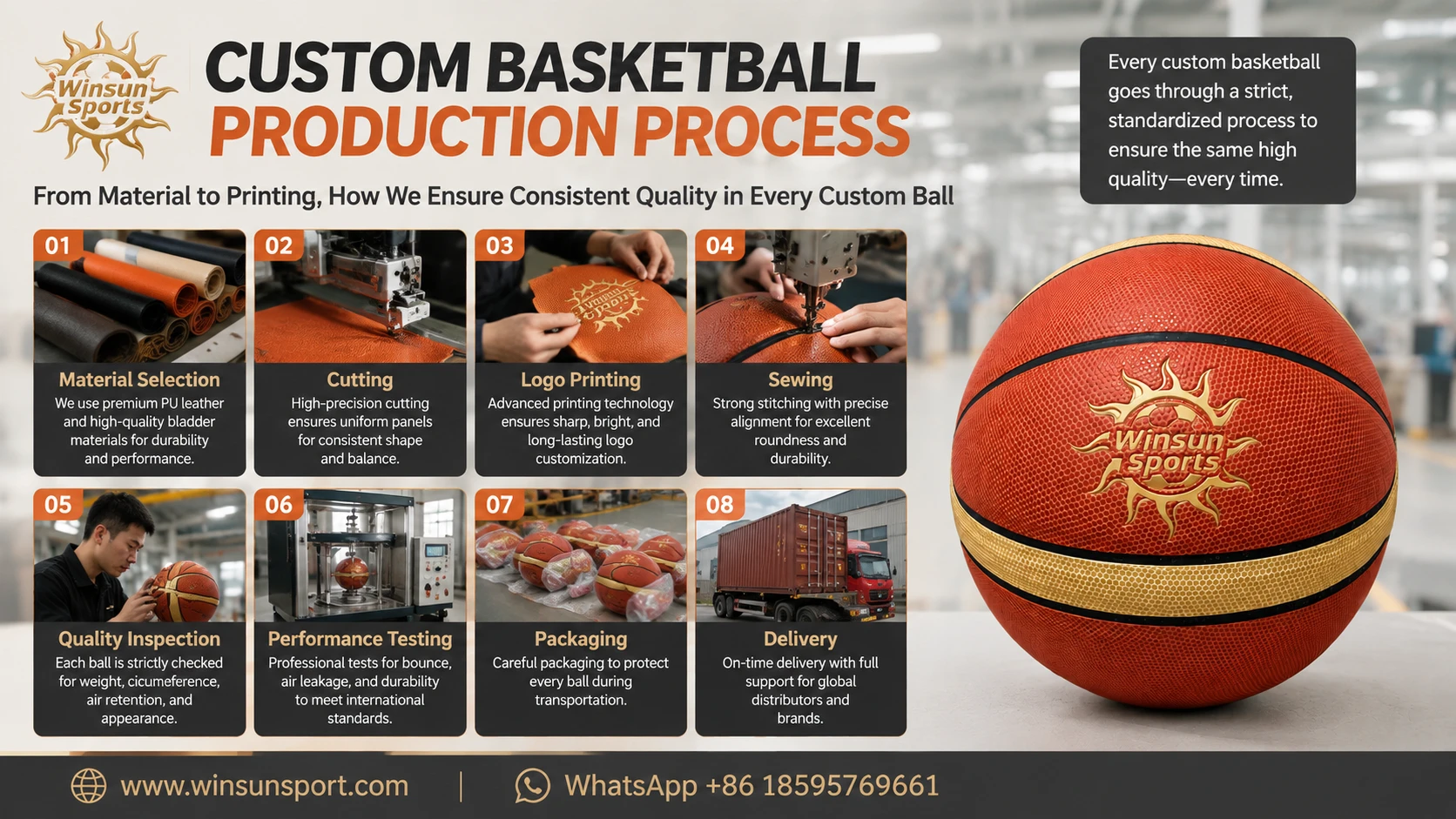
From material selection to factory delivery, how does a factory ensure consistent quality for every custom basketball?
The production of custom basketballs involves multiple stages, each of which affects the consistency of the final product's quality. Understanding the complete process helps in evaluating a factory's quality control capabilities.
What are the key stages in the custom basketball production process?
A complete custom basketball production line roughly goes through five steps:
- Material selection and cutting: Based on the intended use, the surface material (rubber, PU, or genuine leather) is selected, and then the material is cut into fixed-shaped panels.This step determines the ball's durability, feel, and rebound performance.
- Printing and pattern processing: The design is printed onto the panels using methods such as screen printing or heat transfer.This is the core step that distinguishes custom basketballs from ordinary ones.
- Panel stitching and molding: The printed panels are sewn or bonded together in order, then shaped by machine.The neatness of the stitching directly affects the ball's roundness and feel.
- Inflation and quality inspection: The ball is inflated to standard pressure, and roundness, weight, rebound height, and pattern integrity are checked.
- Packaging and Shipping: Sort and package according to order requirements to ensure the balls are not squeezed or deformed during transportation.
Why are material selection and printing process the core of quality consistency?
In the entire process,material selection and printing are the two steps most prone to variation and most affecting the final product quality.。
In terms of material selection, if the source of materials in the same batch is unstable, the weight, elasticity, and abrasion resistance of the balls may vary. For example, for basketballs also labeled as PU material, the thickness and texture of the leather from different suppliers may differ, resulting in some balls being harder and some softer in the same order. Therefore, the factory needs to lock in fixed suppliers and conduct batch sampling inspection upon material arrival.
In terms of printing, the pattern of a custom basketball is printed on the panels, which are curved cut pieces. After assembly, the printed pattern may undergo a certain degree of stretching and displacement. If the factory does not mark the positioning of the cut pieces before printing, or fails to control the ink thickness and curing temperature during printing, problems such as pattern misalignment and inconsistent color shades may occur within the same batch of balls. This is also why sample confirmation is important—the confirmed sample should serve as the quality inspection reference standard for mass production.
Implications for procurement decisions: When requesting quotes from factories, it is recommended to ask three specific questions—Is the pattern printed on the cut pieces or on the finished ball? What printing process is used (screen printing, heat transfer)? Is the confirmed sample used as the quality inspection reference standard during mass production?
The answers to these three questions directly relate to the consistency of quality in batch deliveries.
Material selection determines performance: which scenarios are rubber, PU, and genuine leather suitable for respectively?
The material of custom basketballs directly affects feel, durability, and cost positioning, making it a key link in procurement decisions. Winsunsport custom basketballs support multiple material options, each with clear applicable boundaries.
Why are rubber basketballs suitable for outdoor courts?
The core advantage of rubber basketballs lies inwear resistance, dust resistance, and water resistance。 Outdoor concrete and asphalt courts have rough surfaces, where PU and genuine leather materials wear out quickly, while rubber is designed for such environments. Its surface texture is deeper, maintaining basic grip even on courts with heavy dust.
Scenarios suitable for rubber:
- School playgrounds, community outdoor courts, park fitness areas
- Daily training for children and teenagers (durable and low cost)
- Corporate outdoor activities and promotional balls
Scenarios not suitable for rubber: Indoor wooden floors or plastic courts. Rubber balls feel harder on clean indoor courts, and the finesse of dribbling and shooting is not as good as PU balls.
What are the advantages of PU and genuine leather basketballs in indoor settings?
PU (polyurethane) is a balanced choice for both indoor and outdoor use, and is also the mainstream material for most training and amateur competitions. Its surface is softer and stickier than rubber, providing better ball control, and moderate grip on indoor wooden floors. The wear resistance and price of PU balls fall between rubber and genuine leather.It is suitable for school gymnasiums, training institutions, corporate indoor leagues, and other scenarios.
Genuine leather basketballs area competitive-grade choice, mainly used in professional competitions. Their advantage is that friction increases after absorbing sweat, and over time the leather softens, improving the fit with the hand. But genuine leather balls have two obvious thresholds:higher price, anda break-in period is required—new balls are harder and more slippery, and they only reach their best condition after multiple uses.
In addition, genuine leather balls are basically limited to indoor wooden courts; contact with water or rough surfaces will accelerate aging.
Selection advice:
- Indoor professional matches, high-level training → genuine leather (if budget allows and you can accept the break-in period)
- Indoor daily training, amateur matches, school teaching → PU (best cost-performance ratio)
- Outdoor courts, children's balls, promotional giveaways → Rubber (durable and low cost)
Before purchasing, it is recommended to clarifythe primary venueandfrequency of use。 If the venue is not fixed, PU is a safer choice;If the budget is limited and mainly for outdoor use, rubber is sufficient. Informing the Winsunsport team of the specific usage conditions can help match a more suitable combination of materials and processes.
How to choose the printing process?Which is more durable: screen printing, heat transfer, or hot stamping?
The process used to print the pattern on a basketball directly determines how long the ball will last in real-world use. The core difference among the three processes lies in how the ink or adhesive layer bonds with the ball surface.
What are the process differences among screen printing, heat transfer, and hot stamping?
| Process | Principle | Features | Limitations |
| Screen Printing | Ink penetrates directly into the spherical rubber or PU layer, integrating the pattern with the ball surface. | Best abrasion resistance; slight protrusions do not affect dribbling feel. | Limited color gradations; difficult to achieve gradients or photo-quality patterns. |
| Heat Transfer Printing | The pattern is first printed on a film, then heat-pressed onto the ball surface. | Can present complex colorful patterns | The adhesive layer floats on the surface, and edges may lift after long-term friction |
| Hot stamping | A type of thermal transfer that uses metal foil or special film | Presents a metallic luster or three-dimensional effect, with strong visual impact | Durability is similar to thermal transfer, with the main advantage being visual appeal |
How to choose a printing process for high-frequency usage scenarios?
The judgment criteria mainly depend on usage frequency and site conditions:
- Used more than 3 times per week, mostly on concrete or plastic surfaces: Prioritize screen printing, as its pattern wear rate is significantly slower than surface aging.
- Used 1-2 times per week, mainly on indoor wooden floors: Heat transfer is basically sufficient, and the pattern lifespan roughly matches the ball itself.
- For collection display, gifts, or event prizes: Both hot stamping and heat transfer are acceptable; at this point, pattern precision and texture are more important than durability.
It should be noted that the durability advantage of screen printing is based on the premise that the pattern design is relatively simple. If the custom pattern includes large-area gradients or high-precision portraits, screen printing cannot achieve it, so heat transfer must be used instead, and one should accept the reality that the pattern may wear out before the ball surface. If you need to balance complex patterns with durability, you can confirm with the Winsunsport team whether multi-layer screen printing overlay or hybrid process solutions are supported, as this will directly affect the quotation and minimum order quantity.
Next step: confirm the action: Explain the usage scenario (indoor/outdoor, weekly usage frequency) and pattern complexity (solid color logo or multi-color gradient) to the Winsunsport team, and let them recommend the specific process. If you are still unsure, you can first make a screen-printed sample, try it on the actual playing court for two weeks, observe the edge condition of the pattern, and then decide whether to proceed with mass production.
Sample confirmation and mass production quality inspection: How to avoid inconsistency between sample and bulk quality?
Inconsistency between the sample and bulk quality of custom basketballs is the most common concern for buyers. Samples are usually manually adjusted, while bulk production is batch-produced, and factors such as material batch and printing pressure may cause subtle differences. To reduce this risk, the key is to solidify the sample confirmation process and understand the factory's mass production quality inspection procedures.
What key items should be checked during the sample confirmation stage?
After receiving the sample, it is recommended to check the following items one by one, rather than just looking at whether the appearance is similar:
- Pattern effect: Check whether the colors are accurate, whether there is blurring or white edges, and whether the pattern aligns at the seams of the spherical surface.For multi-color overprinted logos, pay special attention to the accuracy of color registration and whether the distortion of text on the spherical surface is within an acceptable range.
- Size specifications: Use a tape measure to check whether the circumference meets the standard.Taking a standard size 7 ball as an example, the circumference is approximately 75-78 cm. This data directly determines whether the ball meets competition standards and cannot be judged by visual inspection alone.
- Feel and Weight: Compare the sample with a standard ball to feel whether the surface is slippery or tacky, and whether the weight is within a reasonable range.Different materials (PU, rubber, genuine leather) have noticeably different feels; you need to confirm that the sample's feel suits your use case—for example, teaching and training versus competitive play have different requirements for elasticity and slip resistance.
How can the factory ensure consistent quality during mass production through quality inspection?
After sample approval, the quality of the bulk order mainly relies on the factory's quality inspection process. You can confirm with the factory whether the following three steps are implemented:
- First Article Inspection: Before mass production begins, the factory produces a first article (the first batch of the bulk order), and you confirm it matches the sample before continuing with mass production.This step can intercept most process deviations.
- In-process sampling inspection: During production, the factory conducts regular sampling inspections on key indicators such as print fastness, dimensional tolerance, and weight deviation.You can request the factory to provide sampling inspection records, or agree on a sampling ratio (e.g., 5% per batch).
- Pre-shipment inspection: Before shipment, the factory inspects appearance (print defects, surface scratches) and functionality (whether it leaks after inflation, whether elasticity meets standards).For large orders, you can agree on sampling standards, but there must be clear acceptance criteria.
It should be noted that achieving perfect consistency is difficult, but through the above process, differences can be controlled within an acceptable range. Before placing an order, it is recommended to confirm with the Winsunsport team the specific printing process (screen printing, heat transfer, or digital direct-to-garment) and whether the quality inspection process for small batch orders is consistent with that for mass production, so as to more accurately assess the risk of deviations.
Frequently Asked Questions
Q: After sample confirmation, will the mass production be exactly the same as the sample? Not necessarily. Samples are handmade or individually adjusted, while mass production is batch-produced. Differences in material batches, printing pressure, and environmental temperature and humidity can all lead to subtle variations.
Through first article confirmation and in-process spot checks, differences can be controlled within an acceptable range, but achieving complete consistency is difficult.
Q: Will the pattern on custom basketballs fade or peel off? It depends on the printing process and frequency of use. Screen printing and heat transfer have good abrasion resistance, while digital direct printing may be more prone to wear under frequent friction.
It is recommended to test abrasion resistance during the sample stage and inform the factory of your usage scenario (e.g., whether it will be used on outdoor concrete surfaces) so that a suitable process can be recommended.
Q: Can quality be ensured for small-batch customization (e.g., dozens of pieces)? The quality inspection process for small batches and large batches should theoretically be consistent, but small batches may not have a first-article confirmation step, or the sampling rate may be lower. Before placing an order, confirm the quality inspection process for small-batch orders with the Winsunsport team, especially whether the first article is provided.
Q: What if there are obvious differences between the bulk production and the sample? This depends on the contract terms. It is recommended to clarify the acceptance criteria when confirming the order—such as the color difference tolerance for printing, dimensional tolerances, and the criteria for judging appearance defects.
If the bulk goods exceed the agreed standard, you can request rework or negotiate a solution.
Learn More
If you are preparing for custom basketball procurement, feel free to share the usage scenarios, pattern complexity, and budget range with the Winsunsport team, and we will help you match a more suitable combination of materials and processes.
Related Products:Personalized Custom Basketball